Gypsy jazz guitar masterclass In-person lessons in Burgundy, France, with Pascal Borruto: la pompe, improvisation and Django's repertoire
Passing it on
Learning gypsy jazz through the hand, not the theory
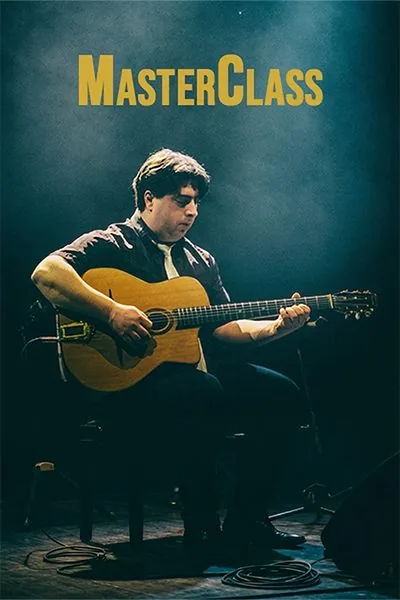
Gypsy jazz is not learned from a book first. It is a music passed on directly, where the sound comes from the right hand before it comes from the notes: the attack, the pulse, the way a chord is allowed to breathe. Pascal Borruto has been playing this repertoire on stage with the Borruto Family for over twenty years, and that is what he teaches — the playing that holds up on a Friday night in front of an audience, not only in a practice room.
The programme
What we work on together
Four areas, approached according to your level and what you are after. Nothing is fixed: a session exists first of all to unblock whatever is blocking you.
La pompe
The engine of the style. Wrist placement, alternating accents, the silence between strokes, and above all steadiness — the one thing that separates a pompe that swings from a pompe that drags.
Rest-stroke picking
The anchored attack, where the pick comes to rest on the next string after striking. This is what gives the style its characteristic volume and bite on an unamplified guitar.
Improvisation
Arpeggios, chromatic approaches, stock phrases and above all construction: how to tell a story over a chord progression, rather than stringing together licks learned by heart.
The repertoire
The standards of Django Reinhardt and the Quintette du Hot Club de France, but also swing, bossa nova and waltzes — the real repertoire of a musician who plays this style live.
In detail
La pompe: the heart of the style
It is the first thing you hear in a gypsy jazz tune, and the last thing you master. La pompe is rhythm guitar played four to the bar, where each beat is in fact a double movement: a short muted stroke, immediately followed by an accented one. The ear hears a single pulse, but it is that double impulse that creates the drive.
The difficulty is not technical in the sense of the fingers: it lies in consistency. A pompe has to hold for six minutes without weakening, without rushing when the energy rises, without being pulled around by the soloist. It is a matter of building an internal metronome, and that is exactly what takes the longest.
In a duo like "The Two Brothers", la pompe is not accompaniment: it is half the band. There is no drummer and no double bass to cover a soft beat. That is the standard we work towards.
Who it is for
All levels, complete beginners included
You are starting the guitar
We begin with the right hand and three chords. Gypsy jazz has this virtue: a beginner can hold a simple pompe very quickly, and play with others within the first few weeks.
You already play, in another style
This is the most common case. The habit to unlearn is the soft pick and the light attack: we go back to the right-hand movement before anything else.
You already play gypsy jazz
Then we work on the precise thing that is stuck: a fast tempo that collapses, arpeggios that do not ring, a solo that goes round in circles. The session starts from your playing, not from a syllabus.
The repertoire
The tunes we work on
Standards are the training ground: they impose a progression, a tempo and an aesthetic, which makes progress measurable. We draw on the repertoire of Django Reinhardt and the Quintette du Hot Club de France, on 1930s and 1940s swing, on gypsy waltzes, and on the tunes the Borruto Family plays live — Douce Ambiance, Swing Gitan, La Gitane. You can listen to them on the Media page before the first session.
In practice
Format, location and fee
Lessons and masterclasses take place in person only, one-to-one or in a group, at all levels. Pascal Borruto is based in Burgundy, France. The location, length and fee are agreed with you according to your project: an introductory session, ongoing tuition, or a masterclass organised by a school, an association or a festival. Tell us what you are looking for and your preferred town; you will receive a clear proposal within 48 h.
Frequently asked questions
Before you start
Do I need a gypsy jazz guitar to start?
No. You can start on any acoustic guitar: the right-hand movement is worked in the same way. A Selmer-style guitar brings the characteristic sound of the style later on, but it is not where you should begin.
Do I need to read music?
No. Gypsy jazz has always been passed on by ear and by imitation. Reading can help you memorise a progression, but it is never a prerequisite.
How long does it take to hold a decent pompe?
A few weeks for a simple, steady pompe at a medium tempo, with short daily practice. Considerably longer to hold a fast tempo through a whole tune — it is a matter of stamina as much as technique.
Are masterclasses open to groups and music schools?
Yes. Masterclasses can be organised for a group, a music school, an association, a workshop or a festival. Describe the setting and the number of participants in your enquiry.
Who teaches the masterclasses?
Pascal Borruto, lead guitarist of the Borruto Family. He has been playing this repertoire on stage for over twenty years, from duo and trio up to quintet.
Do you offer online or video-call lessons?
No. Lessons and masterclasses take place in person only. Pascal Borruto is based in Burgundy, France; tell us your town and the setting you have in mind so we can agree on the location and format.
Tell us about your project
One contact person, a reply within 48 h and a detailed proposal, with no hidden costs.
Request a masterclass